
Best VR Headset for Kids 2026: Safe, Age-Appropriate Picks
Last updated: October 23, 2026
Part of our Best VR Headsets buyer's guide.
The best VR headset for kids in 2026 is the Meta Quest 3S at $349. It is standalone, affordable, and supports parent-managed accounts with app approval and screen-time limits. Meta sets a minimum age of 10 for Quest, with parent controls required for ages 10 to 12, though Meta's own warnings say it is not recommended for younger or smaller-sized children. Whatever you buy, set the lens spacing correctly, keep sessions short, and supervise play. Below are the safest picks and the cheap headsets to avoid.
What actually matters for kids
Four things decide whether a headset is right for a child. Age guidance: follow the manufacturer minimums, 10+ for Quest with parent-managed accounts for 10 to 12, 12+ for PSVR2, 13+ for Vision Pro. IPD fit: the lens spacing must match a child's eyes or the image blurs and strains, and a smaller child's IPD can fall below a headset's narrowest setting. Parental controls: you want app approval, screen-time limits, and content blocking built in. Comfort and supervision: a lighter headset, short sessions, and an adult nearby make the experience safe and fun.
The bigger risk for kids is other people, not the hardware. Social apps and multiplayer games put strangers in the same room as your child, so check those settings before anything else. On a parent-managed Quest account for ages 10 to 12, a parent approves the individual contacts a child can chat with, call and invite, and Horizon Worlds is off until a parent requests access, with voice chat there disabled except for parent-approved contacts, according to Meta. Third-party social apps set their own rules, so check each one's minimum age before you approve it.
1. Meta Quest 3S, the best pick for kids

At $349 the Quest 3S is the most affordable current headset, and it checks every box that matters for a child. It is fully standalone, so there is no PC or console to manage. Meta's parent-managed accounts let you approve apps, set daily time limits, and block titles, all from your own phone through Family Center. And it runs the huge Quest library, including the family-friendly games kids actually want to play. Its one limitation is three fixed IPD settings rather than continuous adjustment, so check the fit for a very young child. It is also our best budget VR headset overall.
2. Meta Quest 3, the step-up family headset
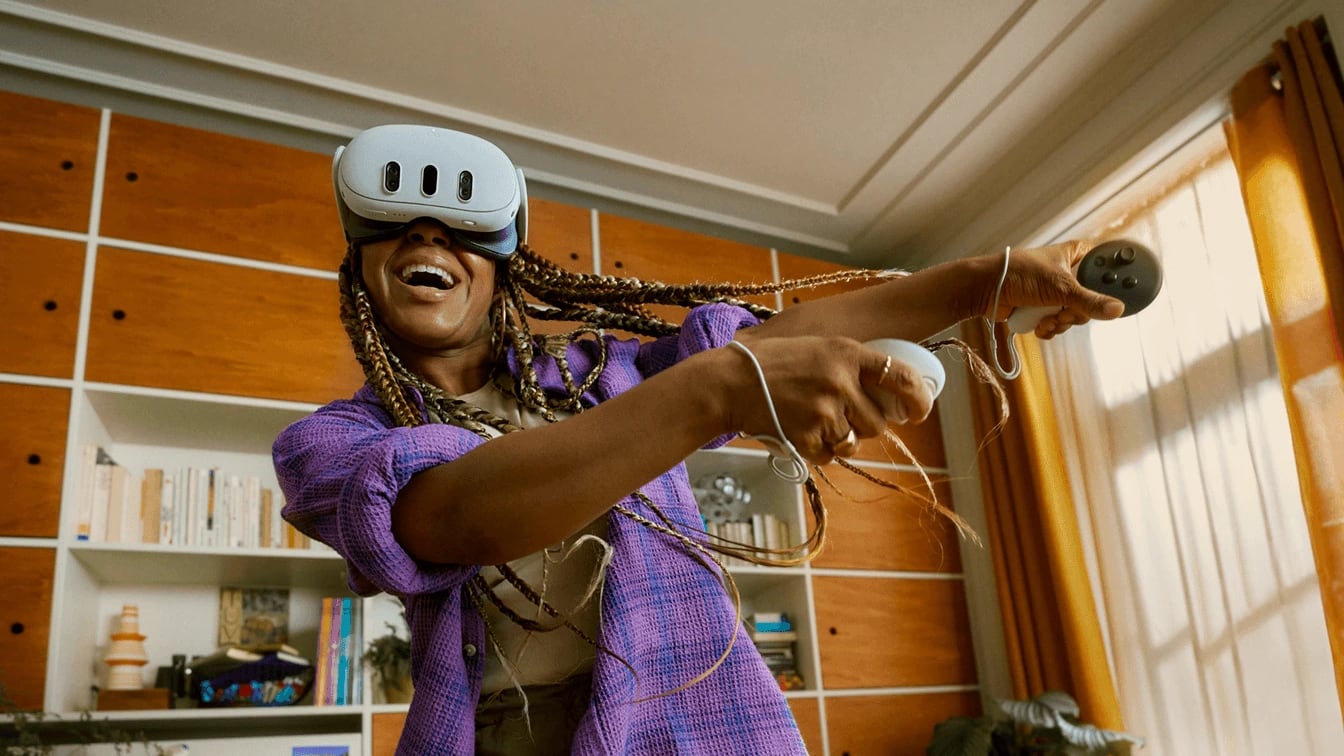
If budget allows, the $599 Quest 3 is the better family headset for one reason that matters with kids: it has continuous IPD adjustment, so it fits a wider range of faces and is more likely to be comfortable and sharp for a younger child. It uses the same parental controls and the same library as the 3S, with better lenses and passthrough on top. If you are weighing the two, our Quest 3 vs Quest 3S comparison breaks down exactly what the extra money buys.
3. PlayStation VR2, for PlayStation families ($399 when in stock)

If you already own a PS5 and your child is at least 12, the PSVR2 is a reasonable option. It plays in the living room tethered to the console, which naturally keeps play in a shared, supervised space, and the PS5's family settings let a parent set playtime limits, cap games by age rating, and switch off PlayStation VR2 for a child's account entirely. It is not standalone and the age recommendation is higher, so it suits older kids in PlayStation homes rather than younger children. The catch this holiday season is finding one: Sony's US store no longer lists the headset, so a PSVR2 in the US today usually means a used or refurbished unit, since the only new ones are third-party Marketplace bundles priced far above the $399 list.
Should you wait for the Quest 4?
No. Meta Connect on September 23 brought no new Quest and no price change. Meta's only new headset, the $1,299.99 Meta VR Glasses, does not go on sale until spring 2027, and reporting puts the gaming-focused Quest 4 no earlier than the second half of 2027, with its price trending up, not down. A Quest 3S bought for the holidays will keep getting the same software and parental controls as everything else in the Quest line. Our Quest 4 tracker sorts every release date and price claim if you want the full picture.
What to avoid
Skip the cheap headsets marketed at kids. The sub-$50 plastic kits you drop a phone into have no real tracking, no controllers, no parental controls, and no proper games, and they cause the blur and motion sickness that put children off VR for good. Also avoid simply handing down an old headset without setting up a separate child account, since that bypasses the age and content controls that keep VR appropriate. Parent-managed accounts work only on Quest 2, Quest 3 and Quest 3S, and Meta says the original Quest and Quest Pro are not approved for anyone under 13. Spend the money on a standalone Quest 3S with a child account instead.
Kids' VR headsets compared
| Headset | Price | Best for |
|---|---|---|
| Meta Quest 3S (128GB) | $349 | Most families and first-time kids, parent controls built in |
| PlayStation VR2 | $399 list (no longer listed on Sony's US store) | PlayStation homes with kids 12 and up, supervised play |
| Meta Quest 3S (256GB) | $449 | Kids who keep many games installed at once |
| Meta Quest 3 (512GB) | $599 | Younger kids who need the continuous IPD fit |
Family-friendly VR headsets compared, with prices from the VR.org deals tracker.
Frequently asked questions
What is the best VR headset for kids?
The Meta Quest 3S at $349 is the best VR headset for kids. It is standalone, so there is no PC or console to manage, it is the most affordable current headset, and it supports Meta's parent-managed accounts with app approval, screen-time limits, and a blocked-content list. It also runs the largest library of family-friendly VR games. Always supervise younger children and check each game's age rating.
What age is appropriate for a VR headset?
Meta sets a minimum age of 10 for Quest headsets, with parent-managed accounts required for children aged 10 to 12 and standard accounts available from 13. Sony says the PSVR2 is not for use by children under 12, and Apple says the Vision Pro should not be used by children under 13. These are the manufacturers' own guidelines, re-verified in October 2026 and unchanged. Valve's own Steam Frame safety guide says the hardware is not for children under 13, and Steam's subscriber agreement does not allow anyone under 13 to hold the account it needs. For any child, keep sessions short, take frequent breaks, and supervise play, since long VR sessions can cause eye strain or motion discomfort. Setting each game's comfort options before handing the headset over helps a lot: use teleport movement rather than smooth locomotion, switch on snap turning, and enable the comfort vignette, which narrows the view during artificial movement.
Is VR safe for kids' eyes?
The American Academy of Ophthalmology says that although there are no long-term studies, ophthalmologists see no reason to be concerned that VR headsets will damage eye development, health or function. Meta's own Quest 3S warnings are more cautious, noting that younger children's visual systems are still developing. The practical risks are eye strain and motion sickness from long sessions, and blur or discomfort if the headset's lens spacing (IPD) does not match a small face. Meta suggests starting with sessions of 30 minutes at most, then a 15-minute break, with more frequent, longer breaks for younger children. Set the IPD correctly and stop if a child reports headaches or nausea.
Why does IPD matter for kids' VR headsets?
IPD is the distance between the centers of your eyes, and the headset's lenses need to line up with it for a sharp, comfortable image. A child's IPD can be narrower than the closest lens setting a headset offers, and Meta warns that a poor fit raises the risk of eye strain, blurry vision, headaches or nausea. The Quest 3 has continuous IPD adjustment covering 53 to 75 mm, while the cheaper Quest 3S has three fixed lens positions (58, 63 and 68 mm) that cover roughly 56 to 70 mm. Check that your child's IPD falls within a headset's range before buying.
What parental controls does the Quest have?
Meta's parent-managed accounts, for ages 10 to 12, let a parent approve which apps a child can download or buy, set daily time limits and scheduled breaks, block specific titles, and watch what their child is seeing in real time. Parents manage all of it through Family Center in the Meta Horizon app on their own phone. On a child's 13th birthday the account becomes theirs and moves into Meta's teen supervision, which stays on by default until parent and teen choose together to turn it off. This is a big reason the Quest 3S and Quest 3 are the best choices for kids: the controls are built in and easy to manage.
Are cheap kids' VR headsets worth buying?
No. The cheap headsets marketed for kids are usually plastic shells you drop a phone into, with no real tracking, no controllers, no parental controls, and no proper game library. They tend to cause blur and motion sickness, which turns children off VR. If you want a real, safe VR experience for a child, a standalone Quest 3S is far better value than any sub-$50 phone-VR kit.